
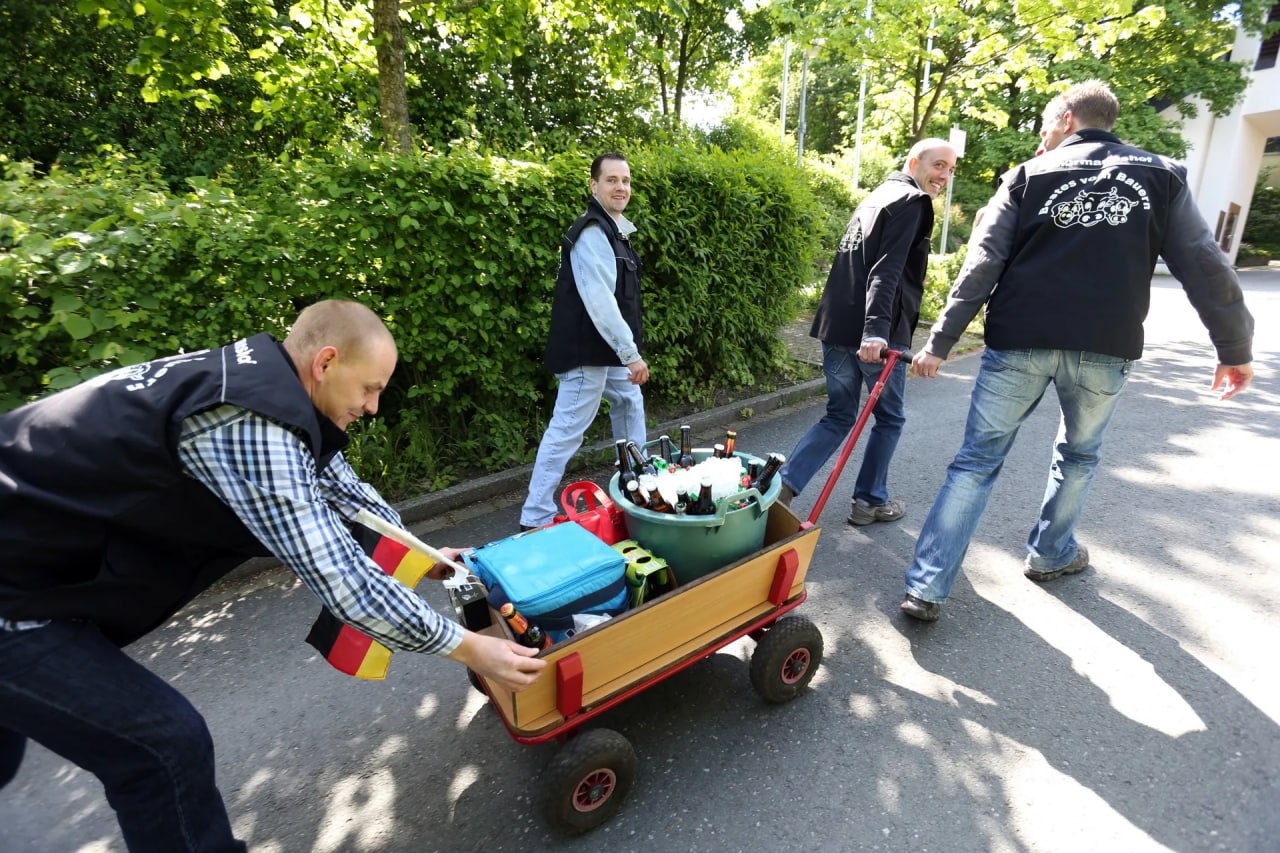
I'm a simple emigrant and I will tell how Father's Day goes in Germany
Tomorrow in Germany they celebrate Vatertag or Father's Day. And here it's not just a date for balancing with Mother's Day, but a real holiday that people look forward to and celebrate even louder than Mother's Day. Especially in smaller towns. Vatertag always coincides with Ascension Day. It's a religious holiday when Christ returned to God the Father. Probably crafty guys decided that if we already honor the heavenly Father that day, why not honor ordinary mortal fathers as well. Church holidays often have a floating date tied to the day of the week. Here it is the Thursday on the fortieth day after Easter. Having slicked themselves up, the men secured themselves a day off on this day, and moreover, immediately long weekends if you take Friday off. Mother's Day here, if anything, is always on Sunday. And joking aside, the tradition goes back to the late 19th century. Initially on Ascension Day in some regions of Germany there were processions. And, after visiting all the fields, men often gathered to celebrate the holiday with feasting and alcohol. And in the 1890s tavern owners in Berlin and surrounding areas began actively promoting the idea of "men's outings" on this free Thursday to increase revenue. As we can see, marketing worked. The Church's attitude to all this is lukewarm. It is not thrilled about the alcohol culture, and that the church holiday has lost all attention. And also strange that the image of the father on this day can be said to be completely opposite of what it should be: instead of a day with family and children — a day with friends and alcohol. Therefore lately many parishes try to reintegrate this holiday back into church life: they hold outdoor services for fathers and children to restore the family context. Nowadays on this day men gather in groups and go out drinking, and being fathers is not even necessary. The main symbol of the holiday is the Bollerwagen, a wooden wagon on wheels, in which children used to be carried. Into it they load a case of beer and head off on a trek. Such groups of guys with decorated wagons, in my opinion, are already a more recognizable image of German spring than March 8. In general, with a sweeping gesture, this day became the most accident-prone for accidents. And local police and insurers confirm that accidents on this day are three times more frequent than usual. And they could have just stayed home and gotten their socks and shower gel. There you go. #holidays #history photo: Stefan Arend